Understanding the Basics of Spring Deflection
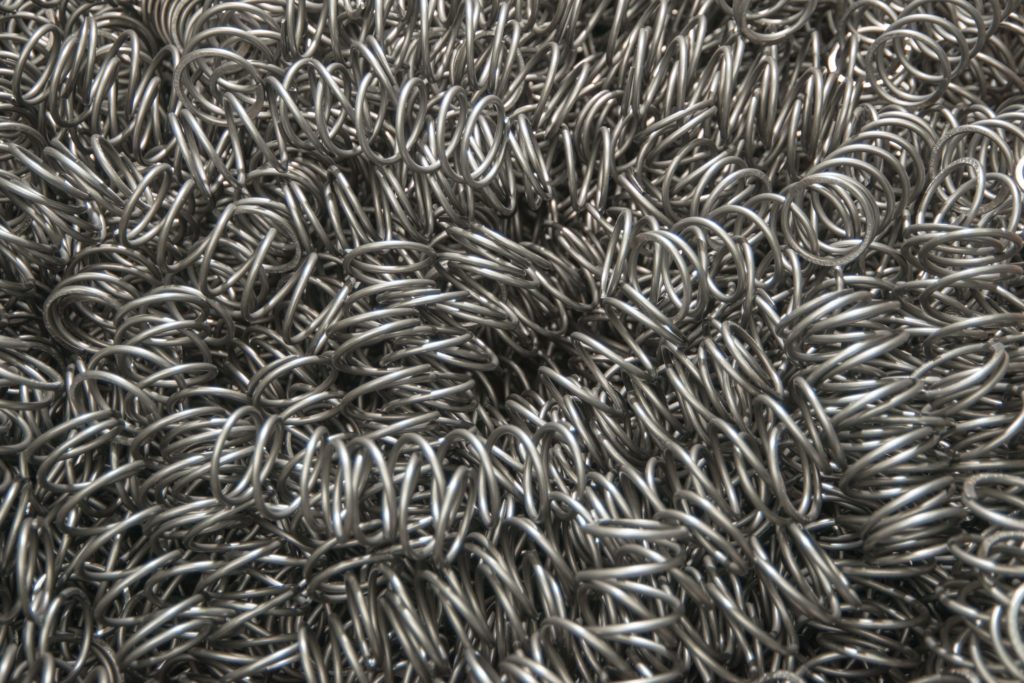
Spring deflection is defined as the motion the spring makes as it moves up and down. Every mechanical spring, including extension, compression, and torsion springs, have a spring deflection (although different terminology is used in the technical definition of deflection depending on the type of spring used). In most cases, deflection is represented in mathematical terms by the letter F, and any external load is represented by the letter P.
Extension and Compression Springs
When it comes to these two types of springs, spring deflection is the motion of the spring ends while the spring is under the effects or the removal of the effects of any external load. Whenever the mechanical spring is pulled tight or released, the resulting motion is deflection.
Extension springs stretch when the load is applied, which means the deflection is the stretching or the compressing of the spring. Compression springs, on the other hand, actually shorten when under a load, which means the cycle of deflection is reversed.
Torsion Springs
In a torsion spring, deflection is slightly different. Here, it’s the movement of the legs or arms of the torsion spring. However, the cause is still the same: the application or the removal of any force on the spring. Torsion springs take the load through twisting or torque force, causing the arms of the spring to rotate when force is applied.
Other Types of Mechanical Springs
There are other types of springs that deal with deflection differently. For example, a constant spring actually has the same load during the entire deflection cycle.
Measuring
You can calculate the deflection of a spring by first figuring out its spring rate. That’s the amount of force it takes for a spring to deflect from point A to point B. If you have this, you can calculate the deflection by dividing the load by the spring rate. If you have an extension spring, there’s one additional step: before doing the division, you have to subtract the spring’s initial tension from your spring load.
If you only know your spring’s load, but not its spring rate, you can still calculate deflection. You simply subtract the spring’s free position from its loaded position.
We Simplify the Equation
When you work with the Yost Superior Co., you don’t have to have an advanced degree in physics or engineering. Our spring design team can help you figure out which type of spring is right for your application or product. Contact our team today to get started on your spring design.